
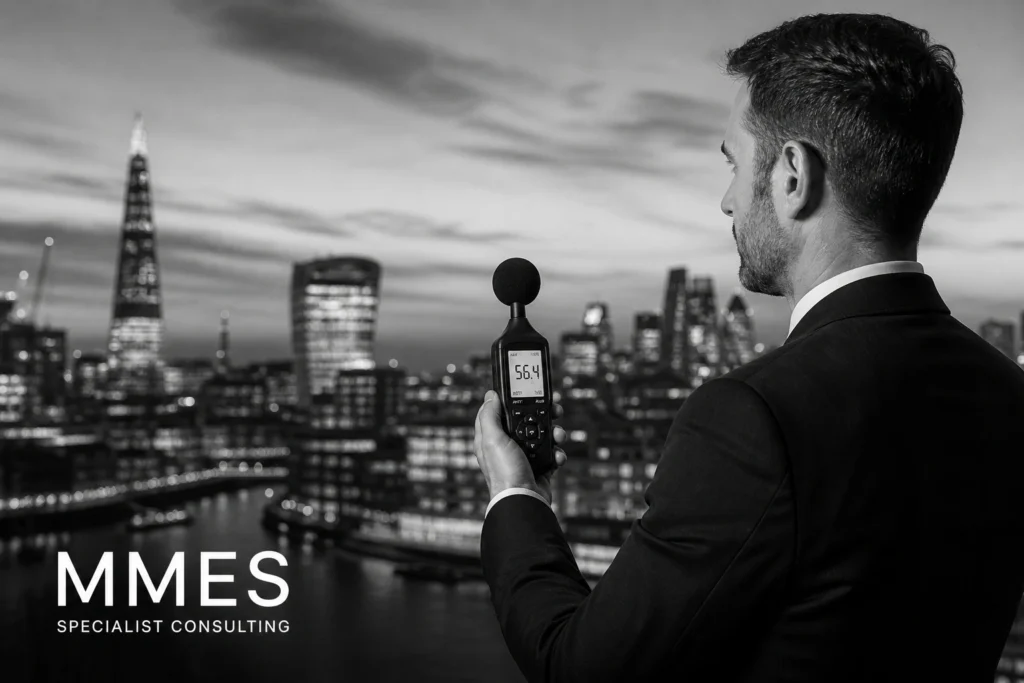
If you have ever been asked by a local authority to submit a noise report before they even look at your planning application, you already know how confusing this space can be. Noise assessment consultants are the specialists who step in at that exact moment — they measure, analyse, and document sound levels so your project can move forward without getting stuck in planning limbo. Whether you are a developer converting a Victorian warehouse in Southwark, a restaurant owner in Camden installing a new extraction system, or a business worried about workplace noise compliance, these are the people you need in your corner. This guide breaks down everything you need to know about what they do, how the process works, what it costs in London right now, and how to choose the right firm for your project in 2026.
What Is a Noise Assessment, Exactly?
A noise assessment is a structured, technical analysis of the sound environment at or around a site, either to establish existing conditions before development or to predict how a proposed development will affect local residents and businesses. It is sometimes called an acoustic survey, a noise impact assessment, or an environmental noise survey — all terms that broadly describe the same process. The output is a formal noise assessment report that a planning authority, environmental health officer, or employer can rely on to make decisions. The assessment covers things like how loud background noise already is, what sources are creating it, and whether a new development will push those levels past accepted thresholds.
The Day-to-Day Role of Noise Assessment Consultants
Most people assume acoustic consultants just point a microphone at something and write a number down. The reality is considerably more involved than that. A qualified noise assessment consultant visits a site, installs calibrated Class 1 sound level meters (sometimes for multiple days or even weeks), analyses the collected data against British Standards and local planning policy, then produces a detailed report with mitigation recommendations. They also liaise directly with planning officers and environmental health teams on your behalf — which in London can be the difference between a smooth approval and months of back-and-forth. Beyond planning, they handle workplace noise surveys under the Control of Noise at Work Regulations 2005, construction noise management, entertainment venue licensing, and even expert witness work for legal disputes.
Types of Noise Assessments You Might Need in London
London’s density and mix of land uses means the city produces almost every type of noise issue imaginable, and different situations require different assessment methods. Here is a breakdown of the most common types you are likely to encounter:
BS8233 Residential Noise Survey — This is required for most new housing developments or residential conversions near busy roads, railway lines, or other noise sources. It measures baseline external noise levels and predicts the acoustic performance needed in windows, walls, and ventilation systems to keep internal levels within acceptable limits for future residents.
BS4142 Industrial and Commercial Noise Assessment — If you are installing mechanical plant — air conditioning units, heat pumps, extraction fans, generators — your local authority will almost certainly ask for a BS4142 assessment. It compares the noise from your equipment against the existing background level and determines whether it is likely to trigger complaints from nearby residents.
BS5228 Construction Noise Assessment — Any demolition or construction project near residential areas may need this, particularly in dense boroughs like Lambeth, Islington, or Tower Hamlets. A Section 61 prior consent application under the Control of Pollution Act 1974 is often submitted alongside this assessment.
Workplace Noise Assessment — Employers have a legal duty under the 2005 Noise Regulations to assess and manage staff exposure to noise. If people in your workplace regularly raise their voice to be heard, or if machinery noise is significant, you likely need this.
Entertainment and Licensed Premises Noise Assessment — Bars, nightclubs, gyms, and live music venues need assessments as part of licensing applications, and sometimes to respond to noise complaints from neighbouring properties.
How Does the Noise Assessment Process Actually Work?
The process typically follows five clear stages, though the timeline and complexity vary by project type. Understanding these steps means you will know exactly what to expect and when, which avoids a lot of unnecessary stress.
Stage one is the initial consultation, where the consultant reviews your project plans, identifies which British Standards apply, and agrees the monitoring scope with you. Stage two is the site survey — unattended sound level meters may be left in position for 24 to 72 hours (sometimes longer), or attended monitoring is carried out where the noise source requires direct observation. Stage three involves data processing, where the raw decibel logs are statistically analysed to extract key figures like the LA90 background level and the LAeq average levels at different times of day. Stage four is report writing, where the consultant prepares the formal noise assessment report with methodology, results tables, assessment conclusions, and practical mitigation recommendations. Stage five is submission and liaison — a good consultant does not just hand you a PDF and disappear. They engage with the local planning authority or environmental health officer to address technical queries and push the application forward.
Qualifications to Look For — Why MIOA Matters
This is an area where many clients make costly mistakes. Not everyone calling themselves a noise consultant has the qualifications or professional standing needed for their reports to be accepted by local authorities. Planning officers in London boroughs routinely ask whether the noise assessment was prepared by a suitably qualified acoustician. In practice, that almost always means a full Member of the Institute of Acoustics, commonly written as MIOA. The Institute of Acoustics is the UK’s professional body for those working in acoustics, noise, and vibration, and its membership requirements involve both academic qualifications and demonstrated professional experience. When you are evaluating firms, asking about MIOA membership is the single most important qualification check you can make. The Association of Noise Consultants (ANC) is another credible body — firms registered with the ANC have agreed to a code of conduct and quality standards that offer additional assurance. At MMES Specialist Consulting, all acoustic work is carried out by appropriately qualified professionals with direct experience of London’s planning environment and local authority expectations across multiple boroughs.
Noise Assessment Costs in London 2026 — What to Expect
Pricing varies considerably depending on the type of assessment, site complexity, monitoring duration, and the turnaround time you need. Below is a realistic guide to what London-based projects are currently costing in 2026.
| Assessment Type | Typical London Price Range | Typical Turnaround | Common Standard |
|---|---|---|---|
| BS4142 Plant Noise (simple) | £350 – £750 | 3 – 7 working days | BS4142:2019 |
| BS8233 Residential Survey (standard) | £600 – £1,500 | 5 – 10 working days | BS8233:2014 + ProPG |
| BS5228 Construction Noise | £800 – £2,000 | 5 – 14 working days | BS5228:2009 |
| Workplace Noise Survey (small site) | £400 – £900 | 3 – 7 working days | Noise Regs 2005 |
| Entertainment / Venue Noise | £700 – £1,800 | 5 – 10 working days | Local policy + WHO |
| Complex Mixed-Use or EIA Noise | £2,000 – £8,000+ | 3 – 8 weeks | Multiple standards |
These figures reflect the current London market. Significantly cheaper quotes should prompt questions about whether the work will be thorough enough to satisfy planning officers, since a rejected or queried report almost always costs more in the long run than paying for quality the first time.
What Goes Into a Noise Assessment Report?
A well-structured noise assessment report is not a simple document — it needs to satisfy technical reviewers who know what they are looking for. The key elements typically include a project description and site context section, a methodology section explaining how monitoring was conducted and for how long, measurement results tables showing LAeq and LA90 values across different time periods, an assessment section comparing those results against the relevant British Standard or planning policy criteria, a section on mitigation options (acoustic glazing specifications, barrier designs, plant silencer requirements), and a clear conclusions section written in a way that directly supports the planning condition or application objective. Local London boroughs sometimes have their own supplementary planning guidance that goes beyond the base British Standards, and a consultant who knows those borough-specific requirements can save significant time and avoid unnecessary additional survey work.
Feature Comparison — Key Services Across Noise Consultancy Types
| Service Feature | Planning Noise Consultants | Workplace Noise Consultants | Environmental Noise Specialists |
|---|---|---|---|
| Primary Client | Developers, architects, planners | Employers, health and safety managers | Local authorities, large developers |
| Main Standards Used | BS8233, BS4142, BS5228, NPPF | Control of Noise at Work Regs 2005 | BS7445, END Directive, WHO guidelines |
| Output Document | Noise impact assessment report | Noise risk assessment report | Noise maps, strategic action plans |
| Regulatory Body Liaison | LPA, EHO | HSE | Environment Agency, Defra |
| Typical Project Length | 1 – 8 weeks | 1 – 3 weeks | Months to years |
| Mitigation Advice Included | Yes — glazing, barriers, plant specs | Yes — hearing protection, engineering controls | Yes — traffic management, noise barriers |
When Do You Actually Need a Noise Assessment in London?
This is the question most clients ask first, and the honest answer is: more often than you might expect. London’s planning authorities have tightened their validation checklists considerably over the past few years. Under the current National Planning Policy Framework (NPPF) and London Plan policies, a noise impact assessment is typically required when a development is near a significant noise source (busy road, railway, underground line, airport flight path, industrial site), when a development involves installing external plant equipment of any kind, when commercial uses are proposed near or above residential properties, when a new leisure or entertainment venue is being licensed, or when construction work could affect neighbouring residents for an extended period. Even relatively modest projects — a rooftop air source heat pump installation, a small commercial kitchen extraction system, or a residential conversion above a shop — can trigger the need for at least a basic BS4142 assessment. Getting that advice early, at pre-application stage rather than after validation is refused, saves both time and money.
Common Mistakes Clients Make When Hiring Noise Consultants
After working on projects across London boroughs, a few recurring mistakes come up again and again. The first is choosing a firm purely on price without checking their qualifications or their track record with the specific local authority involved. Different boroughs have different environmental health teams with different thresholds for what they will accept in a report — a consultant who understands Southwark’s noise policy nuances is genuinely more valuable than a cheaper generalist. The second mistake is commissioning the noise survey too late in the planning process, when there is already pressure to submit quickly. Rushed monitoring periods (sometimes just a single overnight measurement rather than the recommended multiple days) produce weaker data that planning officers push back on. The third mistake is treating the report as the end of the job. The consultant-council dialogue after submission often determines the outcome more than the report content itself. You want a firm that treats post-submission liaison as part of the service, not a billable extra.
Frequently Asked Questions
How long does a noise assessment take in London?
Most standard noise assessments take between five and ten working days from the monitoring period to final report delivery, assuming good site access and no unexpected complications. More complex projects involving multiple noise sources or large sites can take three to eight weeks. If you are facing a tight planning deadline, it is worth asking the consultant upfront whether they can offer an expedited service — many can, for certain types of assessment.
Does every planning application in London need a noise assessment?
No, not every application triggers the requirement. But if your development is near a railway, major road, industrial use, or involves any external mechanical plant, there is a very good chance your local planning authority will request one at validation stage. Checking with a qualified noise consultant before you submit — rather than after a validation refusal — is by far the more efficient approach. You can reach the team at MMES Specialist Consulting for a straight answer on whether your specific project needs one.
What is the difference between a noise survey and a noise impact assessment?
A noise survey refers specifically to the physical monitoring activity — placing calibrated meters on site to record sound levels over time. A noise impact assessment is the broader document that uses that survey data, along with acoustic modelling and standard-based assessment criteria, to reach conclusions about the impact of a proposed development. In most planning contexts, you need both — the survey provides the raw data, and the assessment provides the interpretation and recommendations.
Do noise assessments expire?
There is no fixed expiry date in law, but most local planning authorities and environmental health officers expect noise monitoring data to reflect current conditions at the site. Data that is more than 12 to 18 months old is often queried, particularly in areas where the noise environment may have changed (new road layouts, nearby development, changed industrial operations). If you have an older noise survey from a previous planning attempt, it is worth getting a consultant to review whether it is still defensible before resubmitting.
What qualifications should a noise assessment consultant have?
At minimum, look for full Membership of the Institute of Acoustics (MIOA), which indicates the individual has the academic background and professional experience required for their work to be accepted as authoritative by planning authorities. Registration with the Association of Noise Consultants (ANC) at the firm level is also a strong indicator of quality. Some consultants hold Chartered status through the Chartered Institute of Building Services Engineers (CIBSE) or are full members of the Institute of Environmental Management and Assessment (IEMA), which adds further credibility for complex environmental work.
Why London-Specific Experience Matters
This point gets overlooked surprisingly often. London is not a uniform planning environment — the 33 boroughs each have their own supplementary planning documents, their own environmental health teams, and their own informal thresholds for what counts as an acceptable noise impact. A consultant who has dealt with Hackney’s environmental health team, for example, knows their typical concerns around late-night commercial noise and the specific wording that tends to satisfy their officers. That institutional knowledge is not something you find in a generic acoustic report template. It comes from repeat experience across multiple London projects and ongoing relationships with local authority contacts. The team at MMES Specialist Consulting has built exactly that kind of track record across a range of London development types, from residential conversions to commercial fit-outs, across multiple boroughs. When noise affects your project timeline, that familiarity with the local planning landscape is genuinely worth something.
Conclusion
Noise assessment consultants do considerably more than point a meter at a wall. In London’s complex planning environment in 2026, they are an essential part of getting residential, commercial, and industrial projects through the approvals process without costly delays. From the initial site survey to the final report and everything in between — including the conversations with planning officers that often seal the outcome — the right consultant adds real value at every stage. The key things to look for are proper MIOA qualifications, direct experience with London boroughs and local planning policy, and a service that includes post-submission liaison as standard rather than as an afterthought.
If you have a project coming up that is likely to need acoustic consultancy support — or if you have already received a request for a noise assessment from your local authority and are not sure where to start — the most sensible first step is a straightforward conversation with a specialist. Get in touch with MMES Specialist Consulting to discuss your specific project and find out exactly what kind of noise assessment you need, how long it will take, and what the process looks like from start to finish. No jargon, no unnecessary upselling — just practical advice from people who do this work in London every day. You can also review our privacy policy to understand how we handle your project information.